Théâtre des Vampires
Interview with the VampireThéâtre des Vampires is both a functioning Paris theater and the public mask of a vampire community. Its performances turn killing into spectacle: human spectators applaud what they believe is theatrical illusion while actual vampires enact the capture and death of a mortal woman. Behind the stage, however, the theater opens into a subterranean world of coven rooms, coffins, murals, confinement, and violence. For Louis, the theater first promises revelation and belonging, then exposes the coercive structure of the vampire society he had sought, and finally becomes the building he burns in an act of revenge.
Public Theater and Secret Invitation
Théâtre des Vampires is accessible by invitation rather than ordinary admission. After Louis is attacked in the Latin Quarter, a pale, expressionless vampire intervenes, gives him a card, and invites him to come the following night. The card names the theater and specifies nine o’clock; its reverse instructs Louis to bring the “petite beauty,” meaning Claudia, and identifies the sender as Armand. The invitation therefore functions as both welcome and test: Louis and Claudia are not entering a neutral cultural venue but being admitted into a concealed community that already knows enough about them to recognize Claudia.
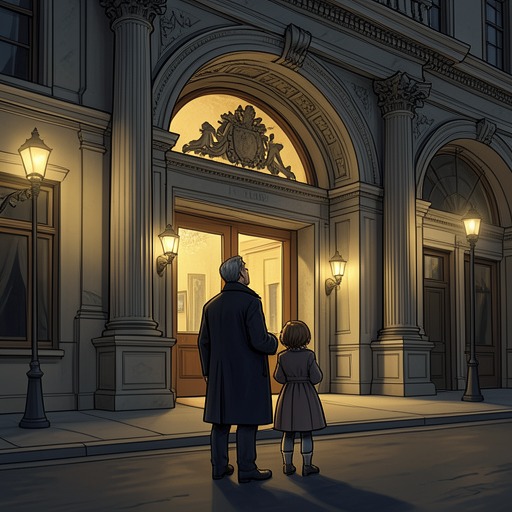
The theater’s public entrance is carefully integrated into ordinary Parisian life. When Louis and Claudia arrive, rain falls over the shut box office and the posters, while human couples press through the lobby among damp wool, gloves, hats, and wet hair. The crowd appears entirely human, and the theater’s ordinary social details help conceal the vampires in plain sight. Louis and Claudia have fed beforehand so that their skin will not look too white and their eyes will not appear too clear, demonstrating that entry depends on maintaining a human appearance as much as on possessing the proper invitation.
Their privileged position deepens the deception. An usher leads them to one of the finest boxes, where Claudia suspects that the theater may employ human slaves. Louis compares this possibility with Lestat’s distrust of human servants, while Claudia urges him to be sly rather than overly gentlemanly. From the box, they occupy the position of spectators looking down at a glittering audience, yet their own presence is also being watched. The theater thus establishes a layered system of spectatorship in which humans watch a performance, vampires watch the humans and one another, and Louis and Claudia are silently assessed by the hosts who have summoned them.
Performance as Predation
The first production makes the theater’s central method unmistakable. Music from tambourine, wooden flute, and strings creates a medieval atmosphere as a painted forest appears behind the curtain. A draped figure enters as Death, carrying a silver scythe and a skull mask. The audience responds with gasps, sighs, laughter, and applause, accepting the scene as a carefully designed illusion. The theater’s artistry is genuine, but it serves to make the audience misrecognize reality.
The production gradually reveals a vampire troupe surrounding a mortal woman. Death first rejects an old woman, cripples, and beggars, turning their pursuit into comedy and drawing uneasy laughter from the crowd. The performance then shifts toward the young woman, whose beauty and vulnerability command the audience’s sympathy. Seven vampires, including three women, gather around her, remove their skull masks, and display their pale faces against her living skin and golden hair. The staging makes the contrast between mortal vitality and vampire coldness into a visual composition, while the audience’s pleasure converts the woman’s terror into entertainment.
The dialogue openly states the logic of the theater’s world. The woman pleads that she does not want to die; the leading vampire answers that death is the one thing every mortal shares and argues that illness or violence could already be waiting for her. When she insists that she is not afraid and will take her chances, the vampire challenges her belief in the future. The scene presents death as an argument, but the argument is also a prelude to consumption. The theater’s language gives predation a philosophical surface, allowing the vampires to perform inevitability before making it physical.
The woman is then passed from one vampire to another and drained before the enthralled audience. Louis tastes her blood and experiences a violent conflict between desire, pity, disgust, and the impulse to kill an usher afterward. Claudia restrains him with the warning to be patient. The actual killing has broken through the theatrical frame, but the audience does not understand what it has witnessed. Once the vampires withdraw and the mortal girl lies naked in a black bier beneath the painted forest, applause unites the crowd; conversation resumes, chairs are straightened, programs are gathered, and the spectators leave in the rain. The theater’s most disturbing achievement is therefore not merely that it stages murder, but that it makes murder indistinguishable from successful performance.
The Subterranean Coven
After the performance, Armand appears at the edge of Louis and Claudia’s box. Louis recognizes him as the auburn-haired vampire who had given him the invitation. Armand’s calm, still manner contrasts with Louis’s anxious gestures and unsettles Louis because it seems to expose the futility of his efforts to understand him. Armand leads them through a lower door and down a stone stairway, away from the auditorium and into rooms beneath the theater.
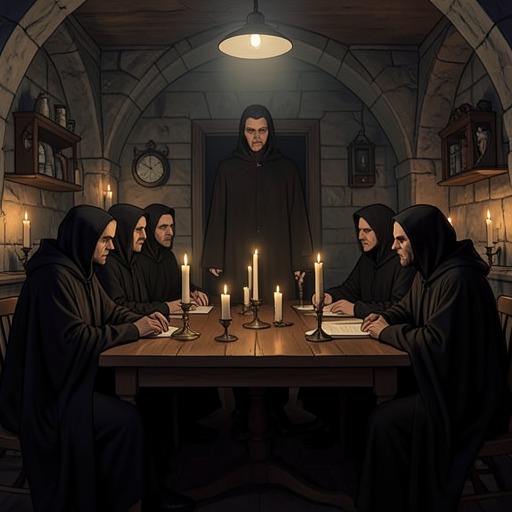
The underground space resembles a vast ballroom carved from an older cellar. Its walls are covered with monumental images, including Breughel’s “Triumph of Death,” where skeletons carry away the dead, pull carts of skulls, behead bodies, and drive armies toward massacre. Another mural depicts “The Fall of the Angels,” with the damned expelled from heaven into a chaos of monsters. These paintings extend the stage’s imagery into the architecture itself. Death is no longer a dramatic role worn by one performer; it surrounds the visitors as an entire visual and spatial order. The theater’s subterranean rooms make the hidden life of the coven appear older, deeper, and more comprehensive than the public performance above.
The descent also changes the direction of looking. In the auditorium, Louis watches vampires pretending to kill. Below it, the vampires control the route, the light, the doors, and the pace of revelation. A young boy carries a candle for Armand, and the candle exposes the murals only gradually. The underground theater is consequently a space of managed visibility: Louis sees what he is led toward, while the coven retains control of what remains in darkness. The building produces community through restricted access and produces fear through the power to close, conceal, and confine.
Imprisonment and Destruction
The theater’s promise of communion becomes openly coercive when Louis, Claudia, and Madeleine are attacked by its vampires. Louis fights Santiago and Celeste and tries to protect Madeleine and Claudia, but he is eventually overwhelmed by sheer numbers. He is beaten, held, forced from the rooms, and pushed into a carriage while Madeleine sobs beside him. He remains conscious through the assault, aware of blood running from the back of his head and repeating to himself that he is alive and conscious.
Inside the theater, the coven’s violence is joined by the return of Lestat. Standing in the ballroom with scars across his white face, Lestat demands Claudia rather than Louis and then tries to reclaim Louis for himself, promising to give him back his life. His appearance reveals that the theater is not isolated from Louis’s earlier history: it has become the institutional setting in which his old relationship with Lestat is revived and weaponized. The coven uses Louis and Claudia as captives, while Lestat attempts to use the coven to restore his control over them.
Louis is sealed in a coffin and hears Madeleine’s cries fade as the vampires carry him away. The coffin is placed near water and deep earth, and bricks are laid around it with mortar, turning his temporary resting place into a tomb. He waits for Armand to come and release them, but the expected rescue does not arrive. The theater’s hidden architecture therefore becomes an instrument of erasure: its victims are not merely attacked onstage or restrained in rooms, but buried alive in a space designed to keep them inaccessible until daylight has passed.
Louis later returns with a scythe, a carriage, and two small barrels of kerosene. With the theater locked against the day and only a short period before dawn, he boards the doors from outside, nails them shut, and proceeds into the lower passage. Armand’s cell is empty and his coffin gone, but Louis finds the furnishings and a dead boy’s enclosed bed. He splashes kerosene across the exposed beams, wooden doors, cells, ballroom chairs, draperies, and corridors, then reaches the theater itself and drenches the velvet curtain, padded chairs, and lobby draperies.
The destruction is interrupted by the doorway where Claudia and Madeleine had been killed. Louis nearly opens it, tempted to confront their remains, but forces himself to continue because they are dead and there is no time or purpose in returning to the scene. He lights a crude torch, sets the theater ablaze, and watches the flames climb through silk, padding, curtains, walls, and the proscenium arch. Santiago emerges through the smoke and curses him, but Louis escapes while the building burns. The fire reverses the theater’s original spectacle: the vampires who had choreographed death for an audience are now trapped inside a consuming illumination they cannot control.
Narrative Significance
Théâtre des Vampires crystallizes the book’s opposition between appearance and reality. Above ground, human spectators interpret predation as fiction; below ground, the fiction is supported by an actual social system of vampires, coffins, cells, and punishments. The theater’s success depends on keeping these levels separate, while Louis’s experience consists of discovering that they were never separate at all. The stage does not merely represent vampiric violence; it normalizes and beautifies it, teaching the audience to applaud what should provoke horror.
The location also becomes a counterpoint to Louis’s earlier enclosed spaces. His coffin in the oratory of the Pointe du Lac plantation marks the moment when he becomes fully a vampire, while Babette’s locked wine room temporarily shelters Louis and Lestat. At the theater, enclosure changes from protection into imprisonment. The same spatial logic that once helped vampires survive the daylight is appropriated by a coven to control other vampires. The theater therefore reveals that vampire community can be built from the very precautions that individual vampires require, but those precautions can just as readily become instruments of domination.
Finally, the theater frames Louis’s relationship to memory and narration. Years later, as he tells his story to the boy beside the turning tapes, the theater remains the place where aesthetic pleasure, longing, murder, captivity, and revenge converge. The boy hears the account as an adventure filled with passion and asks for the power to become a vampire; Louis responds that he has failed to convey its meaning and then attacks him. In that final reversal, the theater’s performance mechanism returns in miniature. A story presented as revelation becomes an encounter in which the listener misreads spectacle as invitation. Théâtre des Vampires thus endures not simply as a ruined building in the plot, but as the governing image of a world where watching death can create desire for the very life that death destroys.